Feature
When quantum meets material science: A leap in single-photon detection
ICFO researchers demonstrate in Science the ability to detect long-wavelength single photons (up to the mid-infrared) at relatively high temperatures.
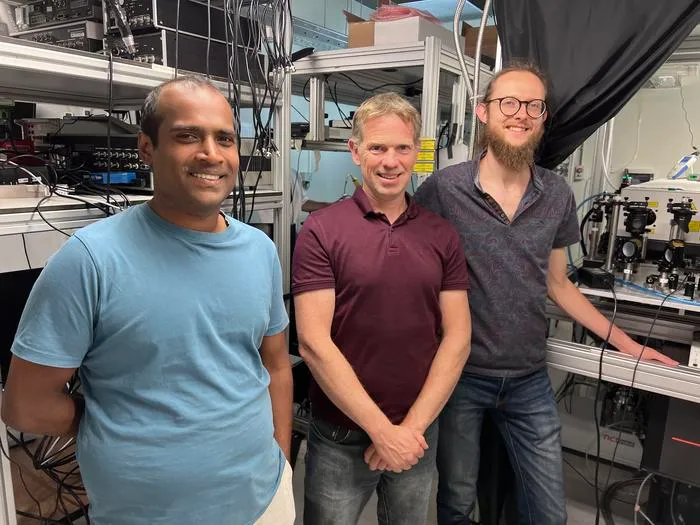
While studying layered two-dimensional materials, ICFO researchers observed an anomaly, an unexpected transition in the system’s state triggered by light. That anomaly turned out to be single-photon sensitivity with extraordinary properties which were previously inaccessible: the ability to detect long-wavelength photons (up to the mid-infrared) at relatively high temperatures.
These longed-for properties, published in Science, open the door to a wide range of applications, from bioimaging to observational astronomy and quantum technologies. The journey until achieving this milestone, however, started long before.
Quantum physics, the first revolution
The 20th century was ushered in by a deceptively simple idea; an idea that would trigger a scientific revolution: energy isn’t emitted or absorbed continuously, but in tiny, discrete packets. Max Planck, unaware of the paradigm shift he was initiating, called these packets “quanta” and regarded them as nothing more than a mathematical trick with no physical reality.
Albert Einstein was the first one bold enough to challenge that view. By theorizing that light was made of these quanta (now known as photons), he managed to elegantly explain the photoelectric effect, a long-standing scientific puzzle that earned him the Nobel Prize in Physics in 1921. This, in turn, laid a key foundation for quantum theory.
Shortly after Einstein put his disruptive idea on the table, the existence of photons gained experimental backing, ultimately becoming an accepted fact. Yet detecting individual photons remained an enormous technical challenge for decades. This is unsurprising: these are the smallest measurable units of electromagnetic radiation, the fundamental building blocks of light. Resolving them required a technological leap that, simply, was yet to come.
Thanks to breakthroughs such as avalanche photodiodes and superconducting nanowires, we have now achieved such a level of precision. Today, single-photon detectors are indispensable across numerous fields, from medical imaging and astrophysics to emerging quantum communication and computation technologies.
Despite the wide variety of efficient technologies and mechanisms available, no single approach has emerged as the gold standard. The main reason is that current detectors can either be sensitive to long-wavelength photons, but only at extremely low temperatures (often below 1 Kelvin), or they can work at higher temperatures, but over a much more limited wavelength range.
Many applications would benefit from detecting single photons in the infrared range at practical temperatures, though. In bioimaging, for example, researchers want to image certain molecules without causing damage, which makes the use of faint light, like that in the mid-infrared range, essential. In observational astronomy, the light from distant celestial objects can be very faint, requiring extreme sensitivity in the mid-infrared. Similarly, in free-space quantum communication (where protocols rely on transmitting single photons across vast distances) operating in the mid-infrared can provide key advantages in signal clarity.
The widespread use of single photon detectors in this range is limited by the need for large, costly, and energy-intensive cryogenic systems to keep the temperature below 1 Kelvin. This also hinders the integration of the resulting detectors into modern photonic circuits, the backbone of today’s information technologies.
Overcoming this apparent trade-off between available wavelength range and operational temperature is the challenge a team led by ICFO has now tackled with success by turning to another, more recent scientific revolution: two-dimensional materials.
2D materials, the second revolution
When graphene, a one-atom-thick layer of carbon atoms arranged in a hexagonal lattice, was successfully produced at the end of the 20th century, the whole scientific community was amazed by its remarkable properties. Flexible, lightweight, and incredibly strong, yet exhibiting a host of rich quantum behaviors, this two-dimensional material quickly became an extremely valuable tool for both fundamental and applied scientists.
But few could have predicted what would follow.
As it turned out, two layers of graphene can create an even more intriguing system. That became evident in March of 2018, when an international team led by Pablo Jarillo-Herrero from MIT reported the discovery of superconductivity after stacking two layers of graphene on top of each other rotated at a very specific angle of 1.1⁰.
A slight twist induces an interference pattern known as the moiré pattern, with a periodicity that depends on the twist angle. “You can see moiré patterns everywhere in nature,” explains ICREA and ICFO Professor Frank Koppens, a longtime expert in 2D materials. “However, here we have a moiré at the scale of atoms, and that completely changes the properties of electrons moving through the material.” At the very specific ‘magic angle’ of 1.1⁰, the electronic properties change so dramatically that exotic physical phenomena – like the discovered superconductivity– emerge.
Here we have a moiré at the scale of atoms, and that completely changes the properties of electrons moving through the material
ICFO researchers have contributed significantly to the field of 2D materials, spanning from fundamental studies of magic-angle twisted bilayer graphene (MATBG) and plasmons in graphene, to the manipulation of such materials for advanced photodetection and light confinement. For instance, in 2019, ICFO led a Nature study that offered a deeper look at MATBG’s unusual behavior, demonstrating its transition from an insulator to a superconductor. The results, which appeared in The New York Times, helped cement MATBG’s status as a truly unique platform.
After that, material scientists from all over the world started stacking and twisting other two-dimensional materials too, hoping for interesting effects –such as correlated interactions and superconductivity– to arise. Exploring the effect of these slight rotations consistently gave rise to exotic physical phenomena, completely transforming the electronic properties of the monolayers on their own. “In our group, we combine different 2D materials. We stack them, twist them, and then observe what happens. And, sometimes, surprises come out,” adds Prof. Koppens.
Merging the two revolutions together
This year, a team led by ICFO has advanced the field of 2D quantum materials even further by adding another exotic property to the list, a phenomenon known as bistability. Bistability allows a system to rest in two distinct states under the same external conditions, like a light switch that can remain in either the “on” or “off” positions. “On the one hand, this is interesting from a fundamental perspective, and could spark new experimental ideas that might reveal new physics,” shares Dr. Krystian Nowakowski, ICFO researcher and first co-author of the paper. “On the other hand, we’ve also shown that bistability can serve as a novel mechanism for single photon detection, which can be interesting for real-world applications.”
The latter is one of those surprises Prof. Koppens was referring to. “We noticed that the material was not behaving as we expected,” recalls the professor, who is the senior author of the article. “So we thought, ‘Let’s shine some light on it and see what happens.’ That’s when we suddenly observed an extreme sensitivity to illumination.” And the deeper they looked, the clearer it became that the material was responding to individual photons.
We suddenly observed an extreme sensitivity to illumination
“When I first saw the device detect single photons, I was both impressed and a bit worried,” shares Dr. Hitesh Agarwal, first co-author of the study and ICFO researcher at that time. “It was so sensitive that even small disturbances, such as opening the lab door, affected it. I immediately wondered how we’d measure something that reactive with precision.” According to Dr. Roshan Krishna Kumar, ICFO researcher who was co-supervising the work, the journey towards single photon detection “was a random walk, from start to finish, which in the end gave rise to some nice physics.”
Single photons: the straw that broke the camel’s back
The detector itself is structurally simple. It consists of bilayer graphene sandwiched between layers of hexagonal boron nitride, another 2D material which acts as a protective shield. The bilayer graphene is not twisted at the magic angle, though; instead, the moiré pattern emerges from the alignment of bilayer graphene with the boron nitride.
“Building the device was tricky,” explains Dr. Agarwal, primarily because achieving the precise orientation between bilayer graphene and hBN had only a 50% success rate. “In the end, we managed to solve it through careful design and lessons from earlier experiments,” he adds.
So how does this device detect single photons? At an intuitive level, the answer can be grasped with a metaphor. Take a huge, empty box on a table, and put a handful of straw inside. Nothing happens. But what if you keep putting in more and more straw? Eventually, the weight will become too much, and the table will collapse.
In the laboratory, the researchers engineered a system at the edge of collapse. “Instead of straw, we have electrical current that is flowing,” says Dr. Krystian Nowakowski, first co-author of the paper. “And when we reach the critical point, the device doesn’t break but suddenly switches from one stable state to another. When a single photon is absorbed, it’s like that final straw; it triggers the transition, and that’s what we detect.”
When a single photon is absorbed, it’s like that final straw; it triggers the transition, and that’s what we detect
But how exactly does a lone photon tip the system? “This is something we would all love to know,” admits Dr. Nowakowski. “We have some hypotheses at the moment, but we need to do more experiments to be able to discern between them.” For now, we’ll have to live with the mystery.
What is clear, however, is that this mechanism is fundamentally different from conventional superconducting or semiconductor-based processes, and even from previous proposals of single photon detection using 2D materials, such as MATBG, which were also based on superconductivity effects.
Yet, it was precisely this mechanism that allowed the device to detect long wavelength photons (up to the mid-infrared) at relatively high temperatures (around 25 Kelvin). “The unique physical mechanism at the heart of our detector’s architecture allows us to break the fundamental limits that held previous technologies back” shares Dr. Kumar. In fact, such a radical change with respect to state-of-the-art technology has attracted the attention of the European Space Agency, which wants to test these detectors for space exploration.
These outstanding results were only possible through deep, international collaboration. ICFO led the experimental work, supported by Pablo Jarillo-Herrero’s group at MIT, which provided additional devices to replicate the effect. Theoretical insights came from the University of Antwerp and the University of Manchester. “When new science meets new technology, you naturally need to bring in expertise from across disciplines,” notes Dr. Kumar. “I think that was essential for our success.”
Looking ahead
Now, the team is focused on making the system more compact and pushing the operating temperature even higher, since this is usually the deciding factor in whether a certain detector will be used at all. However, many more factors come into play when determining whether a given technology will become practical. Perhaps this new method for detecting single photons won’t prove useful for studying distant galaxies, medically relevant molecules, or quantum information carriers, or perhaps it will become a turning point.
It is the mutual influence which makes the enormous possibility of scientific advance
This work highlights how emerging platforms like moiré lattices in 2D materials can be employed to explore fundamental quantum phenomena such as single-photon detection. It is a case of one scientific frontier shedding light on another, echoing Rutherford’s idea that “it is the mutual influence which makes the enormous possibility of scientific advance.”
Whether this particular scientific advance is leaving us on the brink of a new era for single photon detection… Only time will tell.
Reference:
Krystian Nowakowski et al., Single-photon detection enabled by negative differential conductivity in moiré superlattices. Science 389, 644-649 (2025). DOI:10.1126/science.adu5329